Why does evaporation cool a liquid?
Have you ever noticed how your skin feels cool after sweating, or how alcohol feels cold as it evaporates? That sensation is not magic — it’s physics. But why does this happen?
Evaporation cools a liquid because fast-moving (high-energy) molecules escape from the surface, leaving behind slower, cooler molecules that lower the liquid’s temperature.
This simple principle of energy exchange explains not only why sweating cools your body but also why engineers use evaporation for advanced cooling systems in science and technology. Let’s dive deeper into the science behind it.
How does evaporation remove heat energy?
At a molecular level, all liquids are made of constantly moving particles. When heat energy increases, some of those particles move fast enough to break free from the surface and turn into vapor.
Evaporation removes heat because escaping molecules carry away kinetic energy, reducing the average energy of the remaining liquid.
The Science Behind Heat Loss
In any liquid, molecules have different speeds. The fastest ones — those with the highest kinetic energy — can overcome intermolecular attraction and leave the surface. When they do, they take their energy with them.
Here’s what happens step by step:
- The liquid absorbs energy from its surroundings.
- High-energy molecules escape into the air.
- The remaining molecules have less average energy.
- The liquid’s temperature drops.
The process continues until an equilibrium is reached between evaporation and condensation. That’s why, for example, wet clothes dry faster in the wind — the fast-moving air removes vapor molecules before they can recondense.
| Concept | Description | Result |
|---|---|---|
| High-energy molecules | Escape first | Carry away heat |
| Remaining liquid | Lower average energy | Feels cooler |
| Continuous process | Evaporation + air flow | Sustained cooling |
This mechanism doesn’t just cool your skin — it cools everything from industrial systems to power plants using water or other working fluids.
What factors affect the rate of evaporation cooling?
Not all evaporation happens at the same speed. Some liquids cool faster than others, depending on their physical and environmental conditions.
The rate of evaporation depends on temperature, surface area, air movement, humidity, and the liquid’s volatility.
Key Factors That Influence Cooling Rate
Temperature
Higher temperature increases molecular energy, allowing more molecules to escape. Hotter liquids evaporate faster.Surface Area
A wider surface exposes more molecules to air, increasing evaporation. That’s why puddles dry faster when spread thin.Air Movement
Wind or fan movement removes vapor from the surface, keeping evaporation continuous.Humidity
The more water vapor in the air, the slower new molecules can escape. Low humidity accelerates cooling.Volatility of the Liquid
Liquids like alcohol or acetone evaporate faster than water because their molecules require less energy to break free.
| Factor | Increases Rate | Decreases Rate |
|---|---|---|
| Temperature | Yes | No |
| Surface Area | Yes | No |
| Air Flow | Yes | No |
| Humidity | No | Yes |
| Atmospheric Pressure | Lower pressure helps | Higher pressure slows |
When all these factors align — high temperature, large surface area, and good airflow — evaporation becomes a powerful cooling mechanism.
How to demonstrate evaporation cooling scientifically?
One of the best ways to understand evaporation cooling is through simple, hands-on experiments. These are often used in classrooms to visualize heat transfer.
You can demonstrate evaporation cooling by observing temperature drops as liquids evaporate from a surface under different conditions.
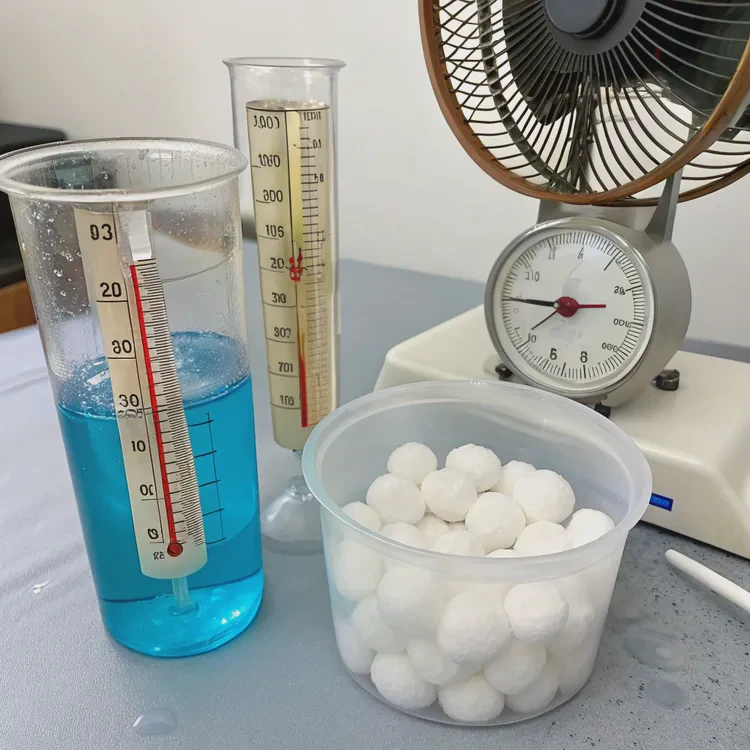
Simple Experiment: Alcohol vs Water Evaporation
Objective:
Compare how quickly alcohol and water cool due to evaporation.
Materials:
- Two thermometers
- Cotton balls
- Rubbing alcohol and water
- Stopwatch
- Fan (optional)
Procedure:
- Soak one cotton ball in alcohol and one in water.
- Wrap each around a thermometer bulb.
- Record the starting temperature.
- Observe temperature changes over 3–5 minutes.
- Optionally, repeat with a fan blowing across both samples.
Observation:
The thermometer wrapped in alcohol will show a faster and greater temperature drop.
Explanation:
Alcohol molecules are lighter and escape more easily, carrying more energy away per unit of time than water. This directly demonstrates how molecular volatility affects cooling.
Scientific Extension
In laboratories, researchers use infrared thermography to monitor evaporation rates or calorimeters to measure energy loss during phase change. These advanced methods help design cooling systems for electronics and aerospace applications.
What role does evaporation play in future cooling tech?
Evaporation isn’t just nature’s way to keep us cool — it’s becoming central to the next generation of thermal management technology.
Future cooling systems will use evaporation through microchannels, phase-change materials, and hybrid vapor-liquid loops to manage heat in compact electronics and energy systems.
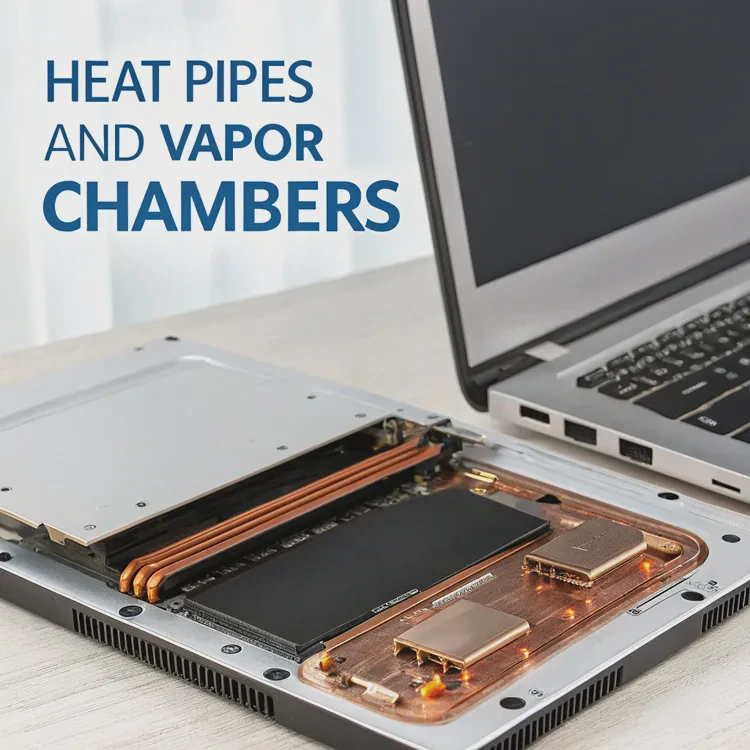
Evaporation in Modern Technology
Heat Pipes and Vapor Chambers:
Used in laptops, these devices move heat using controlled evaporation and condensation cycles inside sealed chambers.Two-Phase Cooling:
Combines liquid and vapor cooling for efficient heat removal in data centers and electric vehicles.Evaporative Air Coolers:
Use water evaporation to cool air without compressors, saving significant energy.Microchannel Cooling:
Circulates coolant through narrow channels, where controlled evaporation maximizes heat transfer.Phase-Change Thermal Storage:
Materials that evaporate and condense store and release heat energy efficiently for renewable power systems.
Looking Forward
As processors, batteries, and renewable systems grow more powerful, engineers are adapting nature’s own cooling method — evaporation — into scalable, high-tech designs. These systems can handle large heat loads using less energy and fewer moving parts, leading to quieter, greener, and more efficient technology.
Conclusion
Evaporation cools a liquid because energetic molecules escape and take heat energy with them, leaving the rest cooler. This natural process powers everything from human temperature regulation to advanced industrial cooling — and it’s shaping the next generation of smart, energy-efficient thermal systems.
TAGS
Latest Articles

Volume discount levels for heat sink orders?
Buyers often ask when heat sink prices start to drop with volume. Many worry they’re overpaying for small orders. This guide explains how B2B volume pricing works for thermal components. Heat sink
21 Dec,2025
Heat sink long-term supply contract options?
Many buyers want stable pricing and reliable delivery for heat sinks. But without a clear contract, risks grow over time. This article explores how to secure better long-term supply deals. Long-term
21 Dec,2025
Tooling cost for new heat sink profiles?
Many engineers struggle to understand why tooling for custom heat sinks costs so much. They worry about budgeting and production timelines. This article breaks down the cost drivers behind tooling.
21 Dec,2025
Heat sink custom sample process steps?
Sometimes, starting a custom heat sink project feels overwhelming—too many steps, too many unknowns, and too many risks. You want a sample, but not endless delays. The process for requesting and
20 Dec,2025
Standard B2B terms for heat sink payments?
When buyers and sellers in B2B heat sink markets talk about payment, many don’t fully understand what’s standard. This can lead to delayed orders, miscommunication, and even lost business
20 Dec,2025
Heat sink pricing factors for large orders?
Heat sinks are vital for many systems. When prices rise, projects stall and budgets break. This problem can hit teams hard without warning. Large order heat sink pricing depends on many factors. You
20 Dec,2025Related Articles
- Does the i9-9900K need liquid cooling?
- How to change liquid in an AIO cooler?
- Which is better, liquid cooled or air cooled?
- Does liquid cooling improve performance?
- Is Interceptor 650 liquid cooled?
- Does the i7-13700K need liquid cooling?
- Does the Ryzen 5 5600X need liquid cooling?
- Heat Sink Manufacturers in the USA
- Heat Sink Manufacturer in China
- Heat Sink Manufacturer in Germany
- Heat Sink Manufacturer in Japan
- Heat Sink Manufacturer in India
Author
Dr. Emily Chen
Chief AI Researcher
Leading expert in thermal dynamics and AI optimization with over 15 years of experience in data center efficiency research.
Categories
Latest Products






Recommend Categories
- Liquid cooling plate Manufacturer
- Industrial Heat Sink Manufacturer
- Standard Heat Sink Manufacturer
- Aluminum Heat Sink Manufacturer
- Copper Heat Sink Manufacturer
- Anodized Heatsink Manufacturer
- Stamping heat sink Manufacturer
- Die Casting Heatsink Manufacturer
- Soldering heat sink Manufacturer
- CNC Parts Manufacturer
Latest Products
- Wholesale Aluminum Radiator
- Water Cooling Plate Kit
- Water Cooling Heat Sink
- Water Cooling Heat Sink Kit
- Stainless Steel Water Distributor
- Server Water Cooling Plate Kit
- Server Liquid Cooling System
- Server Aluminum Cooling Kit
- S19 Full Cover Cooling Plate
- S19 Cooling Plate Kit
- S19 Aluminum Cooling Plate
Contact Expert
Have questions about this article? Reach out to our experts directly.