Standard thickness of Vapor Chamber copper plate?
Many designers struggle to decide on the right plate thickness for a vapor chamber. Choosing wrongly can compromise spreading performance or increase cost and weight.
Typical copper plates in vapor chambers often range from around 1 mm to 5 mm thick; for many mainstream applications they’re around 2‑3 mm.
Let’s dig into how thickness is chosen, how it affects performance, when thicker makes sense, and what tolerances to apply.
What is the typical copper plate thickness in Vapor Chambers?
In many commercial vapor chamber designs the overall height (including the copper plates + internal vapor space + wick structure) is reported as between about 1 mm and 5 mm. For example, one source notes thickness varies between 1 and 5 mm, with ultra‐thin devices (smartphones/tablets) using 1‑2 mm, and high‑performance modules (servers/GPUs) at 3‑5 mm. A design guide states for most applications the total thickness of the vapor chamber does not exceed 3 mm.
From these data points one can infer that a “plate thickness” (just the copper sheet forming the top and bottom of the chamber) might typically be about 0.5‑2 mm each (thus making the total height ~2‑3 mm when assembled).
However in higher‐load applications the total assembly thickness might go to 4‑5 mm or more, implying thicker plates or more substantial internal structure.
If we pick a typical product for reference: a standard copper vapor chamber example is 90×90×3 mm for a 150 W application.
Hence, for many mainstream cooling modules the copper plate thickness is around 2‑3 mm.
In summary:
- Ultra‐thin electronics: total thickness ~1‑2 mm → copper plates likely ~0.5‑1 mm each.
- Mid‐range (PC, GPU, telecom): total ~2‑3 mm → copper plates ~1‑1.5 mm each.
- High‐power modules (servers, power electronics): total ~3‑5 mm or more → copper plates possibly 1.5‑2.5 mm each.
Does thickness affect Vapor Chamber performance?

Yes — plate thickness (and overall chamber thickness) influence several performance factors: spreading area, vapor volume, structural rigidity, thermal resistance, and weight. The key is to balance these trade‐offs.
Key impacts:
- Vapor/void volume: A thicker chamber gives more internal space for vapor and wick structure. More vapor volume can improve heat spreading and capacity because more working fluid and vapor path are available. One design guide notes that “a thicker vapor chamber can transport more vapor, translating into a larger heat carrying capacity.”
- Thermal resistance: If the copper plates are too thin, their conduction from heat source into the chamber might add resistance. Thicker plates reduce conduction drop.
- Mechanical rigidity and bowing: Thinner plates may be prone to warping or deformation under internal pressure or mounting stress. Thicker plates help maintain flatness and vacuum integrity.
- Weight and height penalties: Thicker plates increase mass and height, which may conflict with space or weight constraints (especially mobile/laptop).
- Spreading distance vs heat source size: For small heat source areas, the benefit of adding thickness is marginal; for larger areas or higher flux, thickness helps. A study observed that for small lid sizes a solid copper block might outperform a vapor chamber; beyond a certain size the vapor chamber advantage shows.
When thicker isn’t better:
- If the application demands ultra‐thin form factor (mobile/ultra‐book) then thicker plates defeat the purpose.
- If the heat load is moderate and spreading distance short, the gains from thickness may be minimal but cost and weight increase.
- If the wick and vapor path are poorly designed, just increasing plate thickness won’t fix poor capillary return or thermal wettability.
Design rule of thumb:
- For low‐profile devices aim for the minimum thickness that still ensures structural flatness and sufficient vapor path.
- For high heat flux or large area modules, use moderate to thicker plates to ensure low thermal resistance and high capacity.
- Always evaluate conduction path of the top/bottom plates, wick return path, and mounting loads, not just plate thickness in isolation.
In conclusion: yes — plate/chamber thickness does materially affect performance. The correct thickness depends on heat load, spreading area, device height constraint and reliability/rigidity needs.
Are thicker plates better for high‑power applications?
In many high‐power applications (servers, data centres, GPUs, power electronics) designers indeed favour thicker vapor chamber assemblies (including plate thickness) to handle the increased thermal load. But “thicker” must be qualified: it’s not just plate thickness, but the entire chamber architecture.
Why thicker can help:
- Larger vapor and wick volume: Helps move more heat over larger area.
- Lower conduction resistance: Thicker plates conduct better and stay flatter, improving contact between source and chamber.
- Better mechanical stability: Under high thermal cycles, pressure fluctuations and mounting stress, a thicker plate helps maintain integrity and vacuum.
For example a vendor quotes a variation: total thickness 5.17 mm for a 180W vapor chamber.
But thicker isn’t automatically better:
- If adding thickness increases height beyond budget, it may conflict with device constraints.
- There are diminishing returns: once conduction and spreading are efficient, further thickness yields smaller incremental gains.
- Cost, mass and integration complexity increase.
- If the wick or vapor path becomes less effective (e.g., thicker but same wick structure) then performance could degrade.
Practical guidance for high‑power:
- Increase plate thickness and internal chamber height only if you need increased vapor volume and spreading area.
- Ensure mounting and flatness tolerances are maintained — thicker plate helps.
- Confirm that the increased height does not create thermal interface issues or mechanical clearance problems.
- Balance the thickness increase with other cooling components (fins, cold plates, liquid loops) rather than relying on thickness alone.
In short: yes — for high‐dissipation/high‐flux modules, using thicker copper plates (and thus thicker chamber assemblies) is a valid strategy, provided the rest of the design supports it. It’s one lever among many (wick design, working fluid, chamber footprint, integration) not the only one.
What tolerances apply to Vapor Chamber plate thickness?
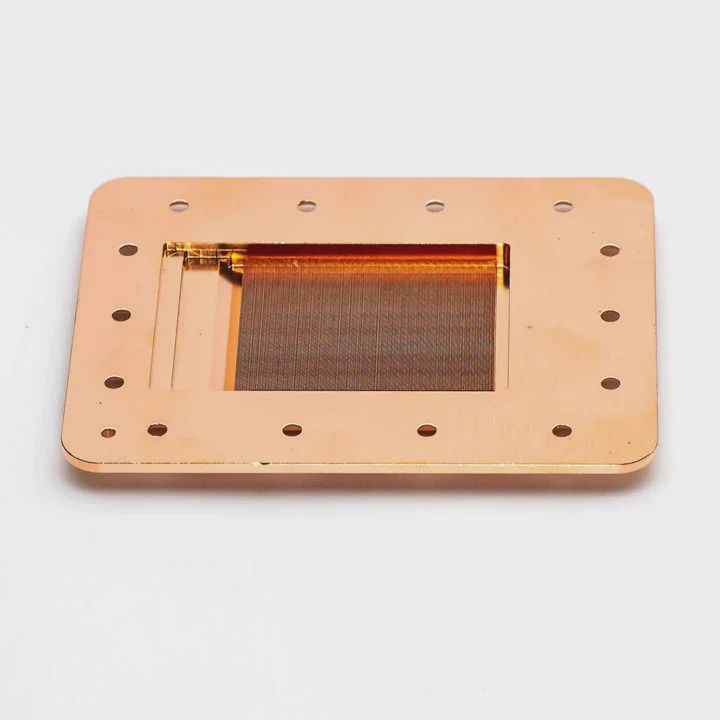
Tolerances on plate thickness, flatness, internal spacing and overall chamber height are critical for quality, reliability and thermal performance of vapor chambers. Since the two plates define the enclosure, their thickness and how evenly they are made affect internal vacuum integrity, deformation under pressure loads, and thermal conduction paths.
Common tolerance parameters:
- Plate thickness tolerance: Manufacturing data sheets often specify a nominal thickness (e.g., 3 mm) and ± tolerance. One vendor notes “Vapor Chamber Flatness, 0.1 mm in every 25×25 mm area” for a 2 mm and up chamber.
- Overall chamber height tolerance: The total assembled height (plates + internal structure) is critical. For example a design guide shows actual product dimensions like 3.00 mm thick, 5.17 mm thick etc.
- Flatness and bow: Because heat source contact requires good flatness, plate bow/twist tolerances matter. Flatness tolerances might be on the order of 0.1 mm or better across a given area.
- Vacuum seal integrity and leak rate: Corporation manufacturing specs will include thickness uniformity and weld/seal integrity since variation affects stress distribution under internal vacuum/pressure cycles.
- Material uniformity and thickness variation: For copper sheets, variation across the plate can lead to thermal non‐uniformities.
What to specify for design/production:
- Set the nominal plate thickness based on application (e.g., 1.5 mm each plate for a 3 mm total).
- Define a tolerance range (e.g., ±0.1 mm) unless there is precision grind/polish.
- Specify flatness (e.g., ≤ 0.1 mm over a 25×25 mm area) and overall height tolerance.
- Ensure that internal vapor gap height and wick thickness are controlled as variation there also affects performance.
- Include specification for thickness variation across the plate (e.g., ±0.05 mm) if uniform conduction is crucial.
Example spec from vendor:
“Vapor Chamber Thickness 2 mm and up; Vapor Chamber Flatness 0.1 mm in every 25×25 mm area.”
This implies that even for a 2 mm thick chamber, flatness must be tightly controlled.
In summary: tolerances for thickness and flatness are essential for vapor chamber performance and reliability. When designing or procuring, oversight of these manufacturing parameters is as important as choosing the nominal thickness.
Conclusion
For vapor chambers used in thermal management, copper plate thickness typically ranges around 1–5 mm total chamber height, with plates themselves often ~0.5–2 mm each depending on device constraints. Thickness affects vapor volume, conduction, spreading and mechanical stability. In high‐power applications thicker plates/chambers make sense, but must be balanced with weight, height and integration constraints. Finally, tolerances on thickness, flatness and chamber height are critical for consistent performance and reliability.
TAGS
Latest Articles

Volume discount levels for heat sink orders?
Buyers often ask when heat sink prices start to drop with volume. Many worry they’re overpaying for small orders. This guide explains how B2B volume pricing works for thermal components. Heat sink
21 Dec,2025
Heat sink long-term supply contract options?
Many buyers want stable pricing and reliable delivery for heat sinks. But without a clear contract, risks grow over time. This article explores how to secure better long-term supply deals. Long-term
21 Dec,2025
Tooling cost for new heat sink profiles?
Many engineers struggle to understand why tooling for custom heat sinks costs so much. They worry about budgeting and production timelines. This article breaks down the cost drivers behind tooling.
21 Dec,2025
Heat sink custom sample process steps?
Sometimes, starting a custom heat sink project feels overwhelming—too many steps, too many unknowns, and too many risks. You want a sample, but not endless delays. The process for requesting and
20 Dec,2025
Standard B2B terms for heat sink payments?
When buyers and sellers in B2B heat sink markets talk about payment, many don’t fully understand what’s standard. This can lead to delayed orders, miscommunication, and even lost business
20 Dec,2025
Heat sink pricing factors for large orders?
Heat sinks are vital for many systems. When prices rise, projects stall and budgets break. This problem can hit teams hard without warning. Large order heat sink pricing depends on many factors. You
20 Dec,2025Related Articles
- How to choose Vapor Chamber supplier?
- Custom Vapor Chamber for High Power Devices?
- Vapor Chamber design service available?
- Can Vapor Chamber improve CPU cooling performance?
- High efficiency Vapor Chamber alternative materials?
- Future demand for Vapor Chamber in EV sector?
- Should Vapor Chamber use pure copper?
- Vapor Chamber lifetime expectation?
- Common defects in Vapor Chamber manufacturing?
- Vapor Chamber pressure leak test method?
- Vapor Chamber performance under vibration?
- Vapor Chamber for industrial robotics cooling?
Author
Dr. Emily Chen
Chief AI Researcher
Leading expert in thermal dynamics and AI optimization with over 15 years of experience in data center efficiency research.
Categories
Latest Products






Recommend Categories
- Liquid cooling plate Manufacturer
- Industrial Heat Sink Manufacturer
- Standard Heat Sink Manufacturer
- Aluminum Heat Sink Manufacturer
- Copper Heat Sink Manufacturer
- Anodized Heatsink Manufacturer
- Stamping heat sink Manufacturer
- Die Casting Heatsink Manufacturer
- Soldering heat sink Manufacturer
- CNC Parts Manufacturer
Latest Products
- Wholesale Aluminum Radiator
- Water Cooling Plate Kit
- Water Cooling Heat Sink
- Water Cooling Heat Sink Kit
- Stainless Steel Water Distributor
- Server Water Cooling Plate Kit
- Server Liquid Cooling System
- Server Aluminum Cooling Kit
- S19 Full Cover Cooling Plate
- S19 Cooling Plate Kit
- S19 Aluminum Cooling Plate
Contact Expert
Have questions about this article? Reach out to our experts directly.