Vapor Chamber industry certification list?
Picking the right certifications is hard. Suppliers of vapor chambers often get confused. Some don’t know what’s required until buyers reject them.
Vapor chamber manufacturers need ISO 9001 as a base, then specific certifications like AS9100, RoHS, REACH, and UL or CE depending on the target industry.
Many buyers ask for certification proof before talking about prices. That makes compliance not just a formality but a business gatekeeper. Below I explain the key certificates and who needs them.
What certifications are required for Vapor Chamber suppliers?
Suppliers often feel stuck. They’re unsure if a certificate is “nice to have” or “must have.”
The key certifications depend on where and how the vapor chamber is used. ISO 9001 is the base. Other standards depend on the industry: aerospace, electronics, medical, or telecom.
A vapor chamber can look simple. But buyers see it as a critical component. If it fails, devices overheat or shut down. So, suppliers must show strong quality systems.
Most buyers expect a certification stack. It starts with ISO 9001 and builds up:
Common Certifications for Vapor Chamber Suppliers
| Certification | Purpose | Industry Relevance |
|---|---|---|
| ISO 9001 | General quality management | All industries |
| ISO 14001 | Environmental management | General / sustainability-focused buyers |
| IATF 16949 | Automotive quality system | EV, automotive electronics |
| AS9100 | Aerospace quality system | Aviation, defense, satellites |
| RoHS | Restriction of hazardous substances | Electronics, EU markets |
| REACH | Chemical safety and registration | EU compliance |
| UL | Electrical safety | US electronics market |
| CE | European safety and EMC compliance | EU electronics market |
| EN 15085 / DIN 6701 | Rail industry welding and bonding | Rail transit systems |
Suppliers should always check with their target customers. For example, a buyer in telecom might need CE or EMC documentation. A buyer in rail transport might ask for DIN 6701 or EN 15085 for structural bonding.
In some cases, even when a vapor chamber is a “passive” part, it still must comply with EMC, RoHS, or thermal safety standards because of where it’s used.
Is ISO 9001 mandatory for manufacturers?
Many factories ask this question early. Some believe experience is enough. But that’s no longer the case.
ISO 9001 is not legally required, but nearly all serious customers expect it. Without ISO 9001, most won’t start technical discussions.
ISO 9001 is the most basic quality system certificate. It shows that the company follows a controlled process for everything: production, inspection, handling, non-conforming parts, and customer complaints.
Buyers often treat ISO 9001 as a “ticket to entry.” It builds confidence that a supplier has process stability, traceability, and documented procedures. Even if your product passes tests, many customers will not trust your long-term reliability without this certificate.
ISO 9001 Brings Business Value
| Benefit | Buyer Trust Area |
|---|---|
| Documented production flow | Consistent quality |
| Corrective action logs | Problem-solving culture |
| Internal audits | Self-checking, continuous improvement |
| Training records | Skilled workforce |
Even small suppliers today need ISO 9001 if they want to grow in electronics, aerospace, automotive, or even consumer markets. It’s not just a paper — it’s a sign that the company runs in a repeatable way.
Are aerospace suppliers required to have AS9100?
This question comes up in any project related to aviation, satellites, or defense. Mistakes here can cost lives.
Yes. For aerospace applications, AS9100 is required. Most aerospace companies will not even consider a supplier without it.
AS9100 builds on ISO 9001. It includes everything in ISO 9001 and adds extra rules for traceability, risk management, production control, and material validation.
Aerospace firms require full batch tracking. Every vapor chamber must have a material certificate, weld record, inspection log, and test report. Any deviation must be documented.
If a supplier uses special processes — like vacuum brazing, laser welding, or diffusion bonding — they may also need NADCAP certification. This shows that those high-risk processes are audited and approved for aerospace quality.
Key Aerospace Quality Tools
- AS9100: Quality management system tailored for aerospace
- NADCAP: Special process certification (e.g., welding, brazing)
- FMEA: Failure mode and effects analysis
- PPAP: Production part approval process
- First Article Inspection (FAI): Verifies new production lots
Aerospace buyers also care about software and documentation. They often ask for DFMEA, PFMEA, control plans, and audit reports. The more complex the system, the more detailed the validation must be.
What standards apply to electronics cooling parts?
Not all vapor chambers go into planes. Many go into servers, telecom racks, or medical electronics.
Electronics cooling parts must meet quality, environmental, and safety standards like ISO 9001, RoHS, REACH, UL, CE, and sometimes EMC testing.
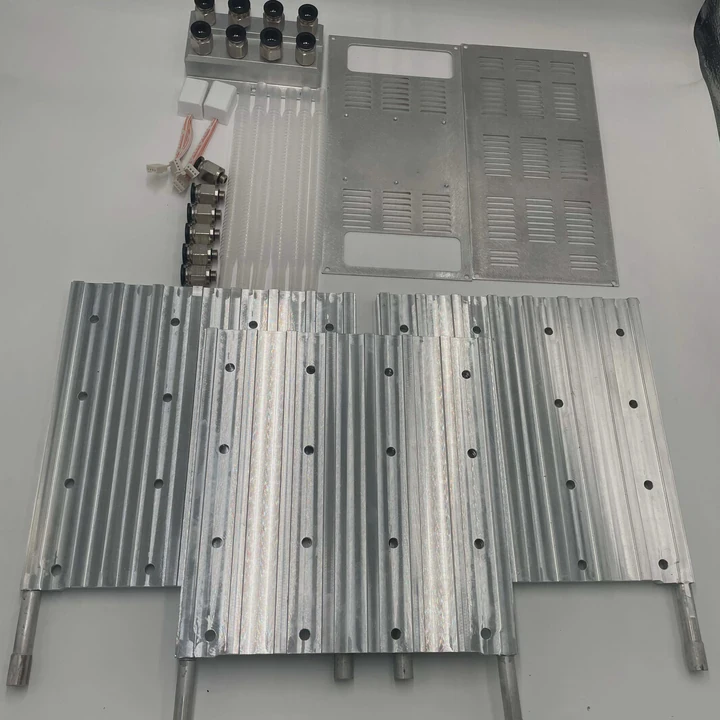
Even though vapor chambers are made from metal, they are still part of systems that touch users or sensitive electronics. So, many standards apply.
If a vapor chamber is used in a telecom base station, then CE and EMC compliance may be needed. If used in a medical device, then biocompatibility or ISO 13485 might be asked. In most cases, RoHS and REACH are a must for global markets.
Compliance Areas for Electronics Cooling Modules
| Category | Related Standards |
|---|---|
| Manufacturing quality | ISO 9001, IATF 16949 (automotive), ISO 13485 (medical) |
| Material safety | RoHS, REACH |
| Electrical safety | UL (USA), CE (Europe), CCC (China) |
| EMC performance | IEC 61000-6-1⁄6-3, EN 55032 |
| Environmental testing | GJB 150A, MIL-STD-810, thermal cycling, shock, vibration |
Also, some electronics buyers ask for full DFMEA reports, thermal simulations, and lifecycle testing data to verify reliability. They want proof that the vapor chamber will last years in high-heat environments.
These standards are not optional in global markets. Customs, certification agencies, and end users all check documents. Skipping them creates business risk.
Conclusion
Every vapor chamber supplier needs ISO 9001 as a base. For aerospace, AS9100 is required. For electronics, you must follow RoHS, REACH, CE, or UL rules. Without the right certifications, even a perfect product won’t reach the customer.
TAGS
Latest Articles

Volume discount levels for heat sink orders?
Buyers often ask when heat sink prices start to drop with volume. Many worry they’re overpaying for small orders. This guide explains how B2B volume pricing works for thermal components. Heat sink
21 Dec,2025
Heat sink long-term supply contract options?
Many buyers want stable pricing and reliable delivery for heat sinks. But without a clear contract, risks grow over time. This article explores how to secure better long-term supply deals. Long-term
21 Dec,2025
Tooling cost for new heat sink profiles?
Many engineers struggle to understand why tooling for custom heat sinks costs so much. They worry about budgeting and production timelines. This article breaks down the cost drivers behind tooling.
21 Dec,2025
Heat sink custom sample process steps?
Sometimes, starting a custom heat sink project feels overwhelming—too many steps, too many unknowns, and too many risks. You want a sample, but not endless delays. The process for requesting and
20 Dec,2025
Standard B2B terms for heat sink payments?
When buyers and sellers in B2B heat sink markets talk about payment, many don’t fully understand what’s standard. This can lead to delayed orders, miscommunication, and even lost business
20 Dec,2025
Heat sink pricing factors for large orders?
Heat sinks are vital for many systems. When prices rise, projects stall and budgets break. This problem can hit teams hard without warning. Large order heat sink pricing depends on many factors. You
20 Dec,2025Related Articles
- Vapor Chamber failure analysis methods?
- Does Vapor Chamber need nitrogen environment?
- Standard Vapor Chamber inspection procedure?
- Vapor Chamber quality documentation samples?
- Can Vapor Chamber be laser cut?
- Vapor Chamber prototype lead time estimate?
- Does Vapor Chamber meet aerospace standards?
- Vapor Chamber import regulations in USA?
- Vapor Chamber REACH analysis documentation?
- How to calculate Vapor Chamber efficiency?
- Vapor Chamber 3D modeling guidelines?
- Are there patented Vapor Chamber designs?
Author
Dr. Emily Chen
Chief AI Researcher
Leading expert in thermal dynamics and AI optimization with over 15 years of experience in data center efficiency research.
Categories
Latest Products






Recommend Categories
- Liquid cooling plate Manufacturer
- Industrial Heat Sink Manufacturer
- Standard Heat Sink Manufacturer
- Aluminum Heat Sink Manufacturer
- Copper Heat Sink Manufacturer
- Anodized Heatsink Manufacturer
- Stamping heat sink Manufacturer
- Die Casting Heatsink Manufacturer
- Soldering heat sink Manufacturer
- CNC Parts Manufacturer
Latest Products
- Wholesale Aluminum Radiator
- Water Cooling Plate Kit
- Water Cooling Heat Sink
- Water Cooling Heat Sink Kit
- Stainless Steel Water Distributor
- Server Water Cooling Plate Kit
- Server Liquid Cooling System
- Server Aluminum Cooling Kit
- S19 Full Cover Cooling Plate
- S19 Cooling Plate Kit
- S19 Aluminum Cooling Plate
Contact Expert
Have questions about this article? Reach out to our experts directly.